
10 Places You Should See on Your First Visit to Buenos Aires

Updated: Jul 30
Buenos Aires is beautiful, but it doesn’t always explain itself.
You can photograph Casa Rosada without knowing why it’s pink, walk past the city’s oldest monument without noticing it, or visit a cathedral that looks more like a Greek temple than a church.
I’ve been a guide in Buenos Aires for eight years, and I still find new stories hidden in streets I’ve walked hundreds of times. That’s part of what I love about this city: it’s elegant and chaotic, European and Latin American, serious and completely absurd—sometimes all at once.
Here are 10 must-see spots, most of which we cover on our Buenos Aires Essential Free Walking Tour.
1. Plaza de Mayo
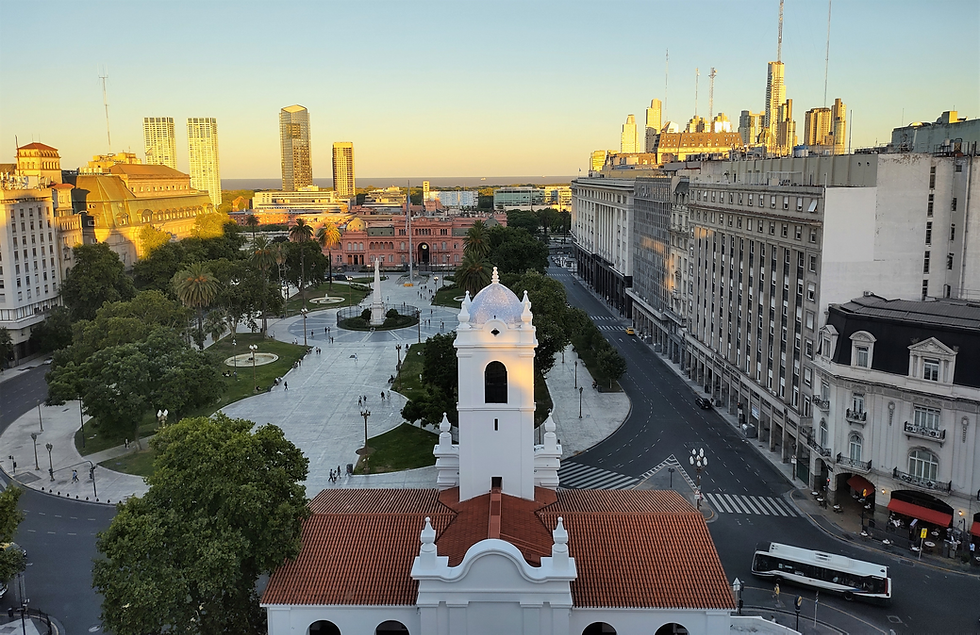
Plaza de Mayo is where Buenos Aires began—and where Argentina still goes whenever something important happens.
The city’s second and successful foundation took place here in 1580. Since then, the square has hosted markets, military ceremonies, revolutions, celebrations and protests. Around it, you’ll find the presidential offices, the old town hall, the Metropolitan Cathedral, the Central Bank and the Ministry of Economy—perhaps the bravest institution in Argentina.
In the centre of the square stands the Pirámide de Mayo, the country’s first national monument. It was built in 1811 to commemorate the first anniversary of the May Revolution.
Look at the ground around it and you’ll also see the painted white headscarves associated with the Mothers of Plaza de Mayo. It’s a small monument carrying an enormous amount of Argentine history.
2. Casa Rosada (Pink House)
Casa Rosada is the seat of Argentina’s national government and one of the most recognizable buildings in Buenos Aires.
The president works here but doesn’t live here. There is even a small detail that can help you work out whether the president is inside: when the presidential flag appears beneath the Argentine flag, it means the president is in the building.
Before Casa Rosada existed, this was the site of a Spanish fortress. At the time, the Río de la Plata reached almost directly behind it.
And why is the building pink? There are two traditional explanations. One involves Argentina’s 19th-century civil wars; the other involves humidity, lime and animal blood. The second one is messier—and probably closer to the truth.
The famous balcony has seen presidents, dictators, football heroes and enormous crowds. Diego Maradona celebrated the 1986 World Cup there, and his funeral was held inside Casa Rosada after his death.
In Argentina, happiness and tragedy often seem to happen in the same places.

3. Cabildo
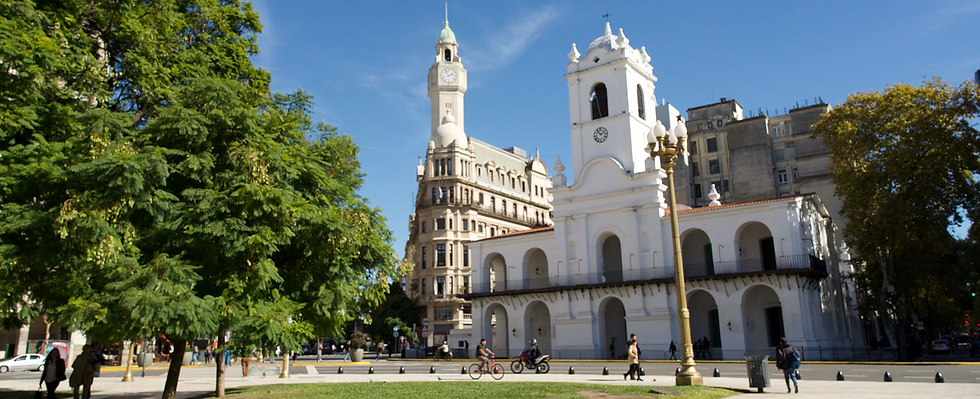
The Cabildo was the political and administrative centre of colonial Buenos Aires. Local authorities met here to discuss taxes, food prices, laws and justice. The building also functioned as a jail.
Most importantly, this is where the events of May 1810 unfolded. After two British invasions, Napoleon’s occupation of Spain and years of frustration with Spanish rule, local leaders established the first autonomous government in Buenos Aires.
4. Buenos Aires Metropolitan Cathedral
Most visitors need a moment to identify the cathedral. From the outside, its columns and triangular pediment make it look more like a Greek temple, a bank or a government building.
There’s a reason for that. This is actually the sixth church built on the same site. The previous ones collapsed or were demolished, and the final version took around a century to complete.
The twelve columns represent the twelve apostles, while the scene above them depicts Joseph meeting his brothers in Egypt. That explains the pyramids and the camel—details you probably wouldn’t expect to find on a cathedral in Buenos Aires.
Inside is the mausoleum of General José de San Martín, who led an army across the Andes and helped liberate Argentina, Chile and Peru.
The cathedral was also the workplace of Jorge Bergoglio before he became Pope Francis in 2013. Long before the Vatican, he was known in Buenos Aires for taking public transport, supporting San Lorenzo and living much more simply than most senior church officials.

5. Avenida de Mayo and Café Tortoni
At the end of the 19th century, Argentina was one of the world’s wealthiest countries. Agricultural exports—especially grain and refrigerated beef—brought enormous fortunes into Buenos Aires.
The city’s elites looked at the old colonial capital and decided it wasn’t grand enough. They wanted Paris.
Avenida de Mayo was part of that transformation. Opened in 1894, it connected Casa Rosada with the future National Congress and was lined with trees, hotels, newspaper offices and elaborate European-style buildings. Creating it required demolishing an entire strip through the city centre.
Beneath the avenue runs Line A of the Subte, the first underground railway line in Latin America, inaugurated in 1913.
This is also where you’ll find Café Tortoni, founded in 1858. It became a meeting place for writers, artists, musicians and political figures.
It’s worth looking inside, although here’s an honest local recommendation: if the queue is enormous, Buenos Aires has dozens of other historic cafés (bares notables) where you can sit down.

6. Avenida 9 de Julio
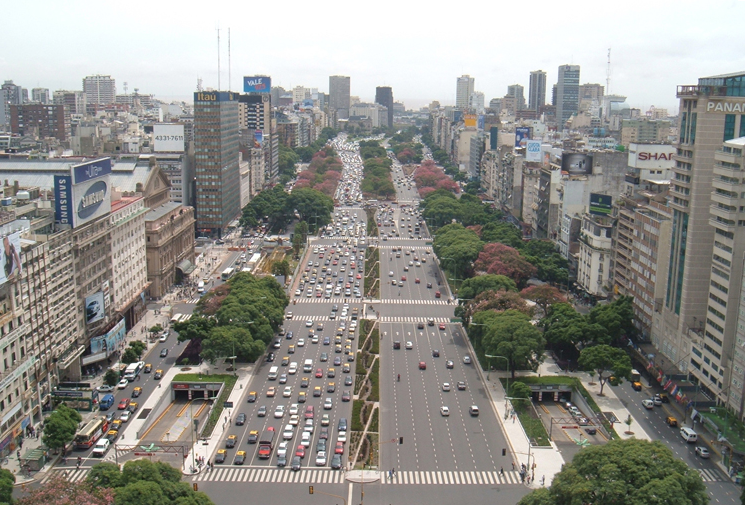
Ask a porteño and Avenida 9 de Julio is unquestionably the widest avenue in the world.
Ask someone who works with official measurements and definitions, and the conversation becomes more complicated.
Either way, it is enormous: around 140 metres wide, with several lanes of traffic, bus corridors and parallel streets. Crossing it normally takes more than one green light.
Building it also required demolishing hundreds of properties over several decades. A few buildings survived in or beside its path, including the former Ministry of Public Works and the French Embassy.
The former ministry is easy to recognize because of the enormous portraits of Eva Perón on its façades. One faces north with a microphone, addressing the city; the other faces south with a calmer expression.
Evita remains one of the most loved, but at the same time debated people in Argentine history. Ask ten locals about her and you may receive twelve different opinions.
7. The Obelisk and Corrientes Avenue
The Obelisk stands where two very porteño obsessions meet.
One is monumental urban planning, represented by Avenida 9 de Julio. The other is entertainment, represented by Corrientes Avenue—with its theatres, bookstores, neon signs and late-night pizza restaurants.
The Obelisk was built in 1936 to commemorate the 400th anniversary of Buenos Aires’ first foundation. That first foundation was a complete disaster: the settlement was abandoned and many of its inhabitants died from hunger, disease and conflict.
So yes, the city’s most famous monument commemorates a failed beginning.
It took only 31 days to build, although locals hated it at first. A historic church had been demolished to make room for it, pieces of its exterior began falling off shortly after construction, and the City Council even approved its demolition. Fortunately, the decision was never carried out.
Today it’s impossible to imagine Buenos Aires without it.
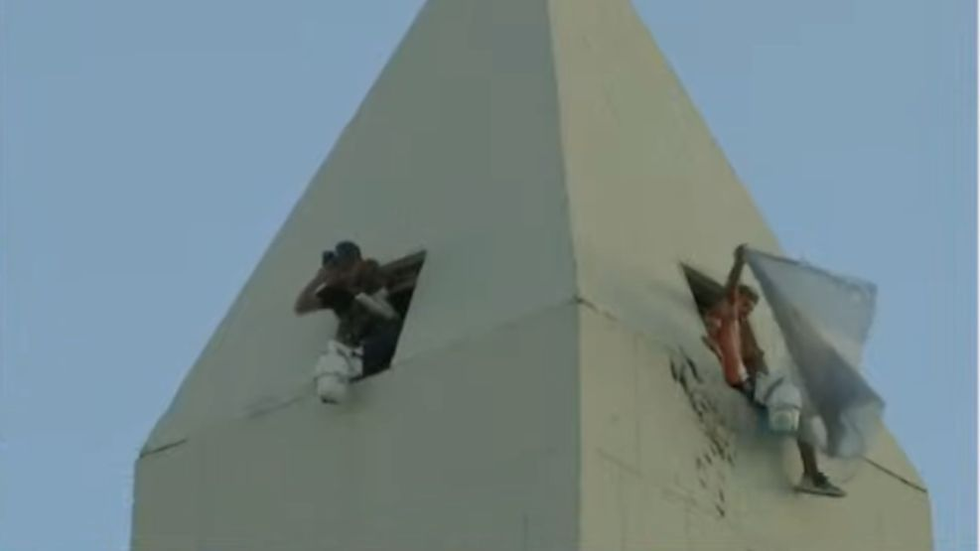
It is also the city’s main celebration point. When Argentina won the 2022 World Cup, millions of people filled the surrounding streets. Some fans even broke into the Obelisk and climbed to the tiny windows at the top, 67 metres above the avenue.
Football here isn’t simply entertainment. At times, it’s the closest thing Argentina has to a common religion.

8. Palacio Barolo
Palacio Barolo is what happens when architecture, literature and obsession are allowed to work together.
The building was commissioned by Italian businessman Luigi Barolo and designed by architect Mario Palanti. Both were fascinated by Dante Alighieri and The Divine Comedy.
The building follows the structure of Dante’s poem: Hell at the bottom, Purgatory through the middle and Heaven at the top. As you go higher, the building becomes brighter and lighter, ending in a lighthouse that represented divine light.
It rises approximately 100 metres because The Divine Comedy contains 100 cantos. When completed in 1923, it was the tallest building in South America.
Today, Palacio Barolo is an office building. You can also take a guided visit up to the lighthouse, which offers one of the best views over Avenida de Mayo and the National Congress.

9. The National Congress
At the western end of Avenida de Mayo stands the Palace of the Argentine National Congress.
Its enormous green dome rises more than 80 metres above the square. The building was intended to represent the power and ambition of a country that, at the beginning of the 20th century, expected to become one of the great nations of the world.
It was designed by Italian architect Vittorio Meano, who also worked on Teatro Colón. Unfortunately, he never saw either building completed.
Meano’s life ended in a domestic scandal involving a forgotten document, his wife, a former employee and a gun. It sounds like the plot of an Argentine soap opera, but it really happened.
In the square outside, you’ll find an original bronze casting of Rodin’s The Thinker. Locals like to point out that the statue has its back turned to Congress—apparently even he has given up trying to understand Argentine politics.

10. Teatro Colón
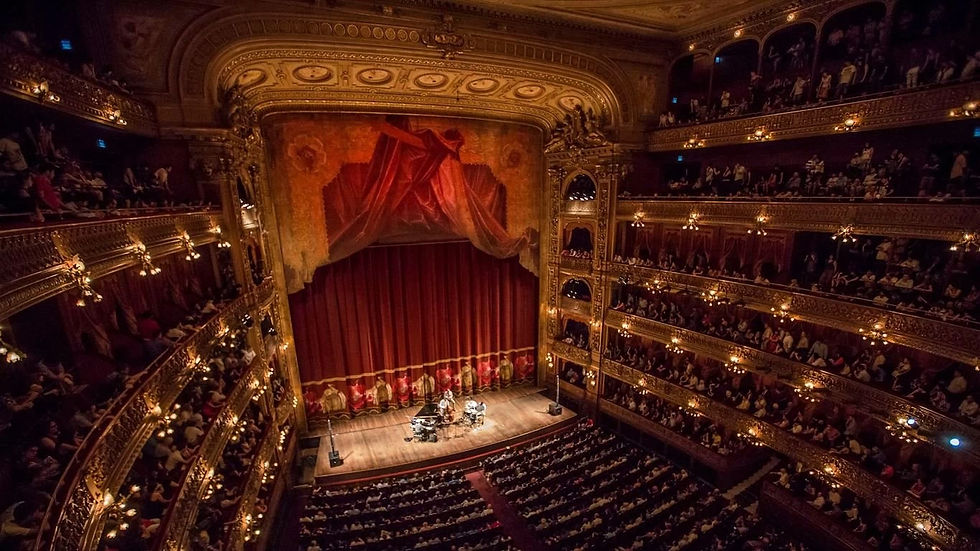
Teatro Colón is one of the buildings that best reflects the ambition of Buenos Aires at the beginning of the 20th century.
It opened in 1908 after almost two decades of construction and several changes of architect. Its main auditorium is internationally famous for its acoustics, and some of the most important singers, musicians and dancers in the world have performed here.
But even if opera isn’t your thing, the building is worth seeing. Its marble staircases, stained glass, golden details and enormous chandelier show the scale on which Buenos Aires imagined itself during its golden age.
Guided visits are available, but it’s also worth checking the programme. Sometimes attending a performance costs less than visiting many of the city’s major tourist attractions.
One Extra Stop: El Ateneo Grand Splendid
We promised ten places, but Buenos Aires has never been very good at respecting limits.
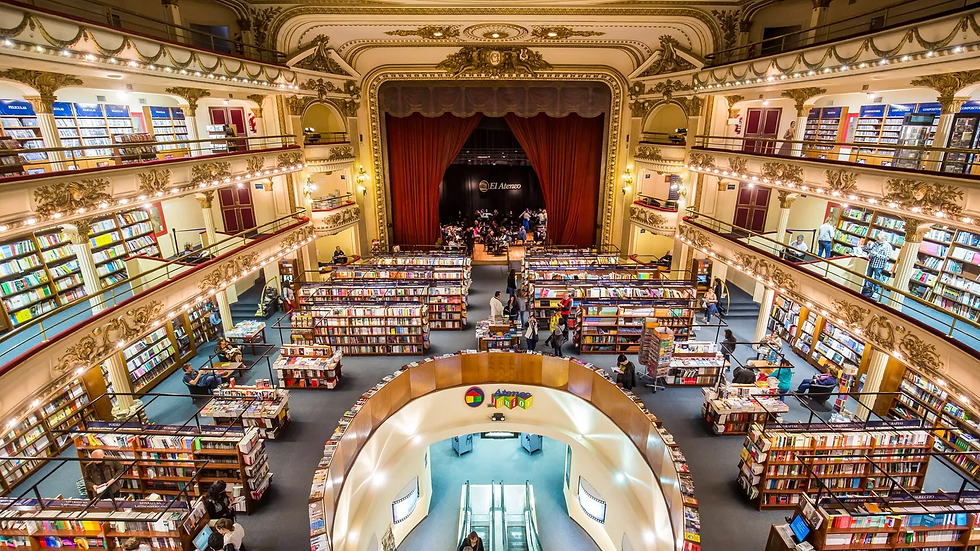
El Ateneo Grand Splendid is a bookstore inside a former theatre. The stage, balconies, red curtain and painted ceiling remain intact, while the old auditorium is now filled with books.
It is undeniably beautiful, but it also represents something very Buenos Aires: a city where bookstores remain part of everyday life and where people can spend hours discussing books, politics, relationships or their latest therapy session over a single coffee.
More Than Monuments
Buenos Aires cannot be understood only through its buildings.
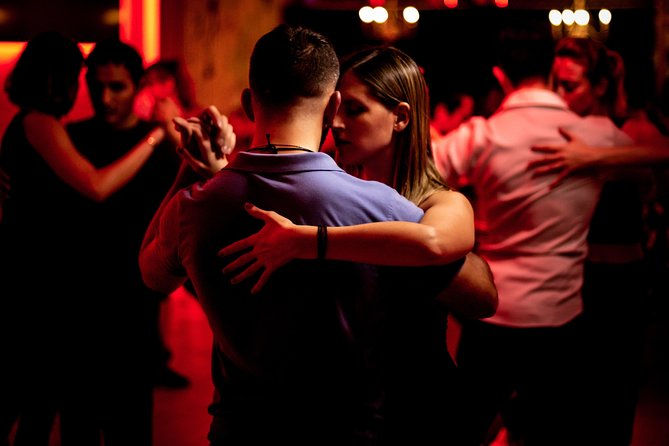
You also need to see friends sharing mate in a park, eat an excessive amount of cheese on a slice of pizza, hear 30,000 people singing inside a football stadium and watch two strangers dancing tango cheek to cheek without exchanging a word.
That’s why our Essential Buenos Aires Free Walking Tour isn’t just a list of dates and landmarks. We use these places to talk about the city’s personality: its immigration, its ambitions, its crises, its rituals and its very particular sense of humour.


Comments