
The History of La Boca: From Working-Class Port to Buenos Aires Icon

Today, La Boca is one of the most recognizable neighborhoods in Buenos Aires. Its colorful houses, tango dancers, football culture and the famous Caminito attract visitors from all over the world.
But La Boca was not created to be picturesque.
Its colors, architecture and culture are the remains of a very different place: a muddy, working-class port neighborhood built by sailors, immigrants and factory workers.
To understand La Boca, we have to start with the river.
A Neighborhood Born from the Riachuelo
La Boca literally owes its existence to the Riachuelo, the small river that separates Buenos Aires from the city of Avellaneda.
Its mouth was not always where we see it today. During the colonial period, sediments and sandbanks gradually blocked an older outlet closer to the city center. By the late 18th century, a new navigable mouth had appeared.
Nearby was a bend in the river already known as the Vuelta de Rocha, named after Antonio Rocha, who had owned land in the area in the 17th century.
The location soon became useful for ships, workshops and naval activities. In 1811, during the first years of the Argentine Revolution, a naval arsenal known as La Maestranza was established here.
La Boca was beginning to find the activity that would define it for more than a century: the port.
The Genoese Arrive
By the middle of the 19th century, a small settlement had developed around the Vuelta de Rocha.
Many of its inhabitants came from Genoa and the surrounding region of Liguria in Italy.
They found a difficult landscape. The land was low, muddy and frequently flooded. Houses were therefore often constructed with practical and inexpensive materials such as wood and corrugated metal, sometimes raised above the ground on stilts.
Color would eventually become another characteristic of these homes.
Today, brightly painted metal walls are part of La Boca's visual identity. But they were not originally created as decoration for visitors. They belonged to the everyday architecture of a poor port community, with a tradition that was strongly influenced by its Genoese inhabitants.
This is one of the keys to understanding La Boca:
What later became picturesque often began as practical.
From Port Settlement to Working-Class Neighborhood
La Boca grew extraordinarily quickly during the second half of the 19th century.
The railway arrived in 1865, connecting the neighborhood more directly with central Buenos Aires. A tram followed in 1870, the same year La Boca obtained its own local administrative jurisdiction.
By 1875, around 12,000 people were already living there.
As Argentina received massive European immigration, the neighborhood became increasingly crowded. Hundreds of conventillos appeared: collective houses where entire families often lived in a single room and shared patios, bathrooms and other facilities with their neighbors.
Conditions could be extremely difficult.
But these buildings also became places where languages, food, music and traditions mixed. Italians, Spaniards and other immigrants lived alongside Argentines in one of the places where the new popular culture of Buenos Aires was taking shape.
A Neighborhood That Organized Itself
La Boca was not only densely populated. It developed an extraordinary culture of community organization.
Immigrants founded mutual-aid societies, cultural institutions, theaters, political organizations and sports clubs.
In 1884, Genoese immigrant Tomás Liberti helped establish the Volunteer Firefighters of La Boca, the first volunteer fire brigade of its kind in Argentina.
The need was very real. In a neighborhood filled with wooden houses, workshops and warehouses, fire was a constant danger.
La Boca also became an important center of working-class politics. In 1904, Alfredo Palacios was elected to Congress from La Boca, becoming the first socialist national deputy in Latin America.
Only a few years later, in 1907, a group of prominent residents even created the humorous Republic of La Boca, complete with its own authorities and symbols.
It was not a serious separatist movement. It was something perhaps more characteristically boquense: an expression of an unusually strong neighborhood identity.
The Neighborhood Where Boca and River Were Born
That same culture of association also produced football clubs.
And remarkably, both of Argentina's biggest clubs were born in La Boca.
River Plate was founded in the neighborhood in 1901. The club played in different locations around La Boca and won its first Argentine league championship in 1920 while still based there.
Boca Juniors followed in 1905, founded by a group of young men from the neighborhood. According to tradition, part of the founding meeting took place on a bench in Plaza Solís.
For a time, therefore, Boca-River was not a rivalry between the north and south of Buenos Aires.
It was a neighborhood rivalry.
Their histories eventually separated.
River left La Boca in 1923, first moving north to Alvear and Tagle and later to its monumental stadium near Núñez.
Boca also briefly left the neighborhood, moving to Wilde in 1914. But it returned.
And that decision would become fundamental to its identity.
River left. Boca stayed.
Why La Bombonera Looks Like That
Boca eventually settled on Brandsen Street, where a wooden stadium opened in the 1920s.
In 1940, the club inaugurated the concrete stadium the world now knows as La Bombonera.
Its extraordinary shape was partly the result of a very practical problem: there was not enough space.
Instead of leaving La Boca to find a larger piece of land, the architects adapted the stadium to a constrained urban block. The stands rose steeply, placing tens of thousands of spectators unusually close to the field.
The result became one of football's most recognizable stadiums.
Even the origin of the nickname La Bombonera is uncertain. The most popular story connects it to architect Viktor Sulčič and a box of chocolates — a bombonera — whose shape supposedly reminded him of the stadium he was designing.
Whether or not the story is exactly true, the nickname stayed.
Pizza, Tango and the Nights of La Boca
Italian immigration transformed much more than the architecture.
La Boca became one of the important places in the development of Buenos Aires' distinctive pizza culture. The Banchero family became particularly famous, and their historic pizzeria on Avenida Almirante Brown, opened in 1932, is closely associated with the popularization of fugazza con queso.
The Genoese connection is visible again: fugazza is related to the Ligurian fugassa, or focaccia.
La Boca also had an intense nightlife.
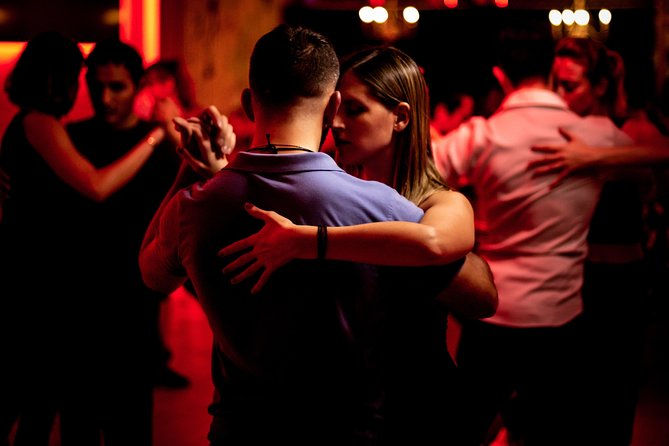
For much of the 20th century, Necochea Street was lined with cantinas serving Italian food, wine and music. The neighborhood was also deeply connected with the early history of tango.
Ángel Villoldo, composer of El Choclo, performed in La Boca. Composer Juan de Dios Filiberto lived here. Bars, dance halls, theaters and conventillos formed part of a much larger popular cultural world.
It would be too simple to say that tango was "born in La Boca." Its origins belong to a broader world on both sides of the Río de la Plata.
But La Boca was undoubtedly one of its great early territories.
Factories, Trains and Bridges
The La Boca of the early 20th century would be almost unrecognizable to someone who knows only today's Caminito.
It was industrial.
Factories, railway lines, warehouses and workshops occupied large areas of La Boca and neighboring Barracas. Companies such as Alpargatas, Canale and Noel became part of this industrial landscape.
And towering above the Riachuelo was one of the neighborhood's most remarkable pieces of infrastructure.
The "Puente Transbordador Nicolás Avellaneda" opened in 1914.
Instead of carrying traffic across a conventional roadway, a suspended platform transported people, carts and vehicles from one side of the river to the other while allowing ships to continue navigating the Riachuelo.
A much larger concrete bridge, also called Nicolás Avellaneda, opened alongside it in 1940.
The two bridges remain one of the best places to understand La Boca's original relationship with its river.
Quinquela Martín: The Man Who Painted La Boca
And then we arrive at the person who perhaps did more than anyone else to shape the image of La Boca that survives today.
Benito Quinquela Martín was born in Buenos Aires in 1890, abandoned as a baby and later adopted by a working-class family from La Boca.
As a young man, he worked carrying bags of coal in the port.
Later, he became one of Argentina's best-known painters.
Again and again, Quinquela painted the world he knew: ships, cranes, smoke, fire, workers and the Riachuelo. His paintings transformed the industrial port of his childhood into monumental scenes full of movement and color.
But Quinquela did much more than paint his neighborhood.
As his career became successful, he invested heavily in La Boca, donating land and buildings for educational, cultural and health institutions.
A school.
A museum.
A theater.
A children's dental hospital.
Public spaces.
His idea of art extended far beyond the canvas. And eventually, he turned an abandoned piece of railway land into his most famous creation.
Caminito
What we now know as Caminito had once been part of a small railway branch.
After the railway disappeared, the site deteriorated.
Quinquela and other local residents helped transform it during the 1950s into an open-air museum, filling the space with art and the bright colors associated with the traditional architecture of La Boca.
There is another wonderful twist to the story.
The famous tango Caminito, composed by Juan de Dios Filiberto with lyrics by Gabino Coria Peñaloza, was not originally about this street.
Coria Peñaloza's lyrics were inspired by a path in the province of La Rioja connected with a youthful love.
The La Boca passage was later named Caminito in honor of the already famous song.
Today it is difficult to imagine one without the other.
From a Working Port to a Symbol of Buenos Aires
La Boca reached its demographic peak around 1914, when approximately 76,000 people lived in the neighborhood.
Then the world that had created it began slowly to disappear.
Port activity declined. Industries closed or moved. Railway infrastructure lost importance. The Riachuelo ceased functioning as the great working port around which the neighborhood had developed.
La Boca lost population and economic importance.
And yet, something almost paradoxical happened.
As the working La Boca declined, the symbolic La Boca became stronger.
Quinquela and others preserved and reinterpreted the memory of the old neighborhood. The colored metal houses, port imagery, tango culture and fiercely local identity became symbols not only of La Boca, but of Buenos Aires itself.
Today, thousands of visitors walk through Caminito, visit the Bombonera and photograph the Vuelta de Rocha.
It can sometimes feel like a stage set.
And in a sense, part of it is.
But the elements of that stage are references to a very real history.
The corrugated metal recalls the homes of working-class immigrants.
The colors recall the old port neighborhood.
The Italian food recalls generations of Genoese immigration.
The tango recalls the popular culture that developed in the streets, bars and conventillos of southern Buenos Aires.
The football clubs recall an extraordinary culture of neighborhood associations.
And the Riachuelo explains why all of it appeared here in the first place.
Quinquela did not simply paint La Boca.
Eventually, he helped paint La Boca itself.
And perhaps that is the best way to understand the neighborhood today: not as a perfectly preserved piece of old Buenos Aires, and not simply as a tourist attraction, but as an artistic memory of a working-class port that helped shape the identity of the entire city.


Comments